01Inspiration
Years ago, a friend and I discussed Debussy's Clair de lune and Beethoven's Moonlight Sonata: which sounded more like moonlight? She chose Debussy, because “Beethoven sounds like someone banging on your door in the middle of the night.” When I listened to Beethoven, though, I pictured someone standing by a railing at night, silently watching moonlight flow like still water.
The same piece of music can bring completely different images to mind. I wanted to make a game out of that exchange: choose a picture, explain why the music made you think of it, and hear how others understood it.
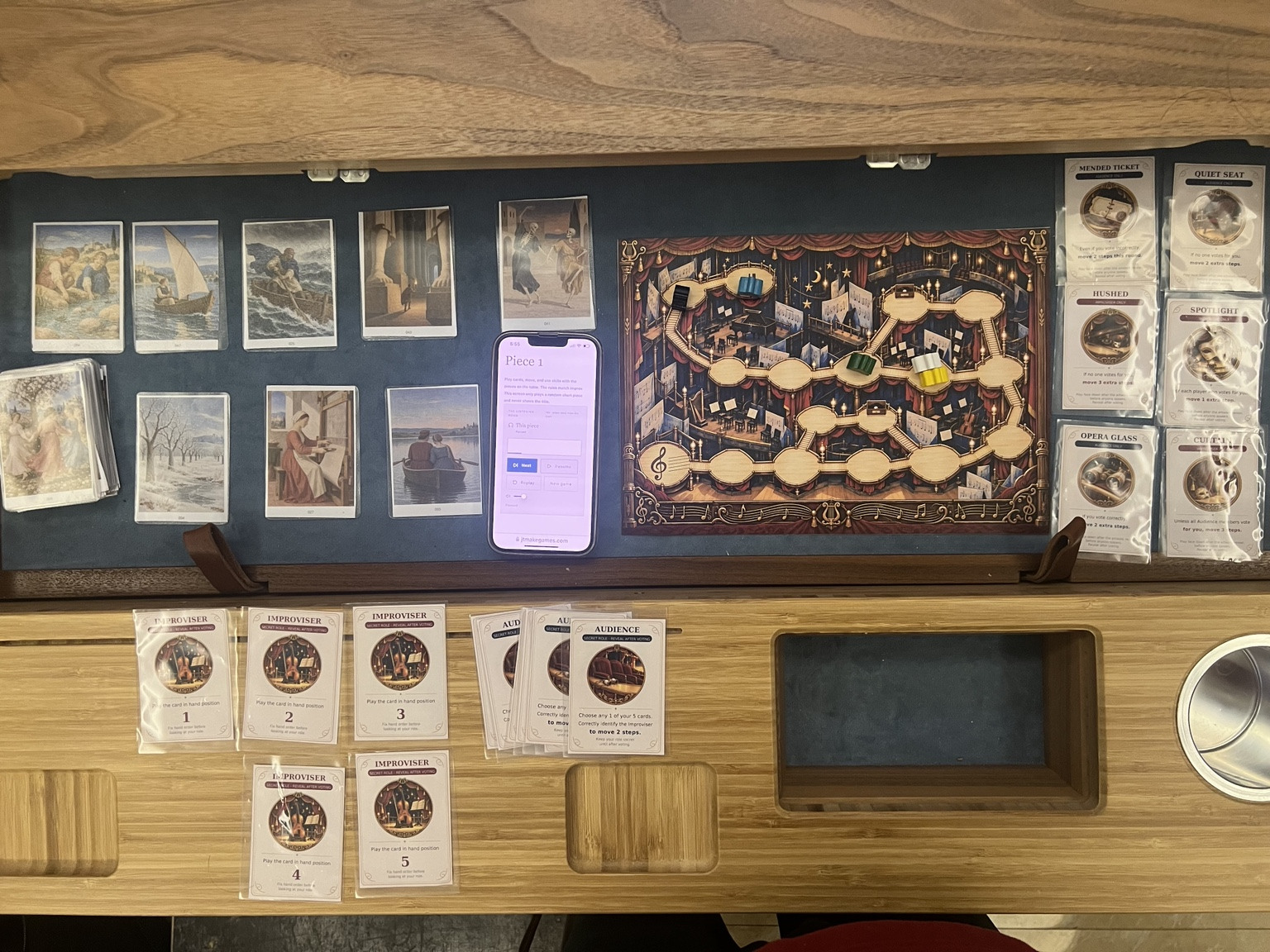
In JukeBox, players listen to music, choose illustrations, and explain the connection. Most can choose their cards freely. One person must use an assigned card without letting the others find out.
02Early roles and win conditions
The earliest prototype had five players: an Author, a Spy, and three Civilians. Each held five illustrated cards. The Author and Civilians formed a team against the Spy.
Everyone first listened to three pieces of music. The Author secretly selected the target piece and an illustration. The Spy learned the target before choosing a card; the Civilians chose without knowing it. Once everyone had chosen, the target music was revealed, followed by the cards and explanations. Players then guessed each other's roles.
The Author and Spy could choose a picture to fit the music, while the Civilians had to find a connection for a card they had already chosen. I hoped that difference would lead to interesting explanations, but the win conditions were difficult to resolve.
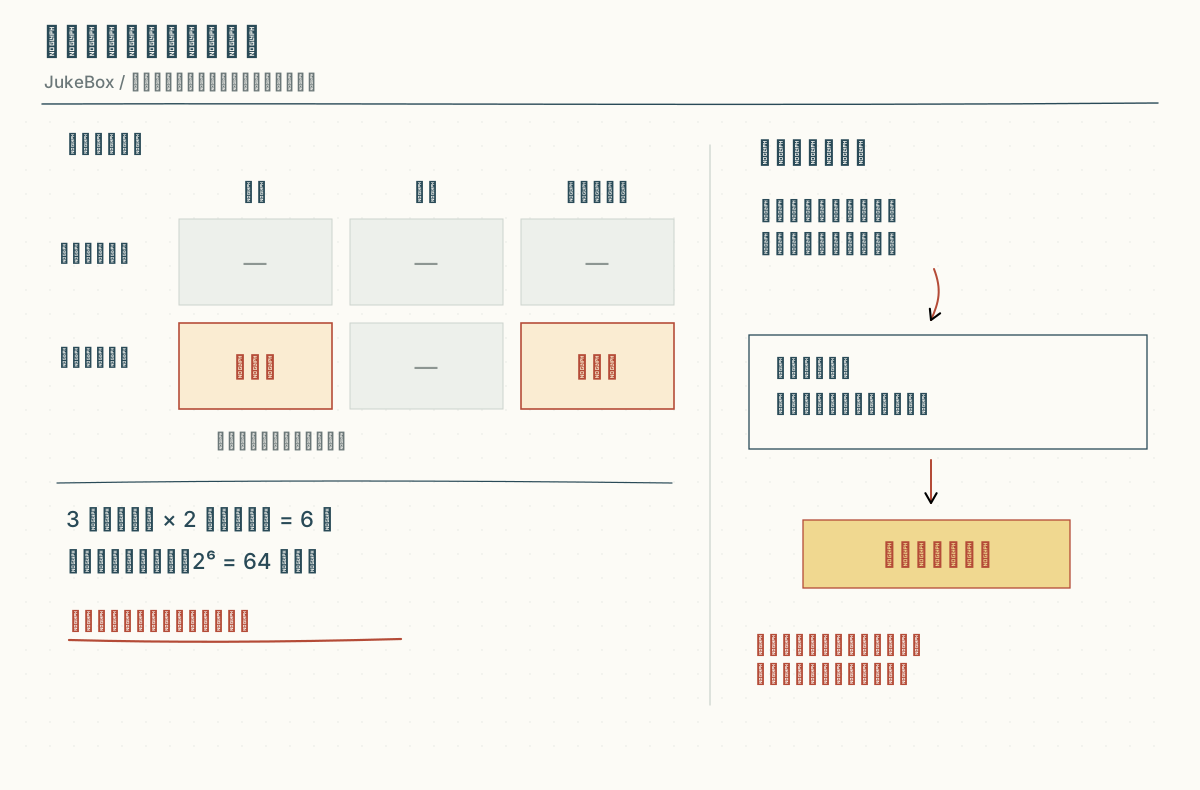
I listed the possible outcomes of a round. A Civilian could vote for the Author, the Spy, or another Civilian: three possibilities. The Spy could identify the Author correctly or incorrectly: two possibilities. Together they formed six cells. If each cell could award victory to either the Author's team or the Spy, there were 2⁶, or 64, possible arrangements. I compared different allocations and considered draws, trying to give every role a reason to participate seriously.
One version allowed the Author's team to win if the Civilians voted for either the Author or another Civilian, provided the Spy guessed the Author incorrectly. The diagram marks those two outcomes.
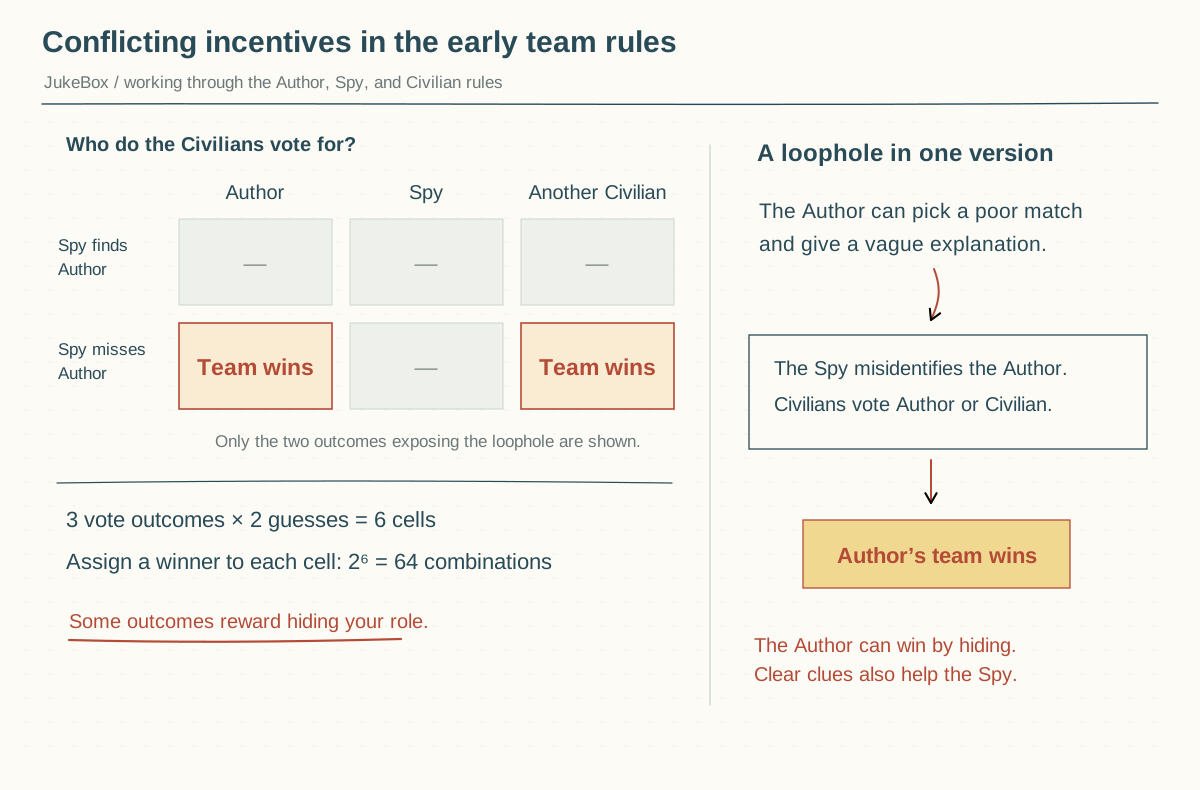
This meant the Author could deliberately choose a less fitting picture to look like a Civilian. The Civilians did not need to recognize the Author either: as long as they avoided voting for the Spy and the Spy guessed wrong, their team still won. I found this loophole while working through the rules. The win conditions were encouraging vague explanations.
The Author also faced conflicting incentives. They wanted the Civilians to recognize them, but the Spy heard the same explanation. A clearer clue could help teammates and the opponent at the same time.
03Simplifying roles and scoring
I first tried moving from team victories to individual points. In one version, the Author scored by being recognized by Civilians and identifying the Spy. The Spy tried to be mistaken for the Author while avoiding the Author's suspicion. Civilians could also score by improvising explanations that made the Author believe they had known the target beforehand.
Individual scoring made it easier to adjust each role's rewards, but added more conditions to remember. In some versions, the Civilians and Spy were both pretending to be the Author, making those two roles increasingly similar to play.
My original reason for making the game was to hear someone explain the image they heard in the music. I did not want complicated roles and scoring to take up too much attention. I decided to simplify, removing the Author and the choice of three target pieces so the rules could focus on choosing cards and explaining them.
Now each round uses one piece of music, known to everyone. Most players choose freely from five cards. Only the secret Improviser must play an assigned card. After hearing the explanations, everyone tries to identify the person who had no choice.
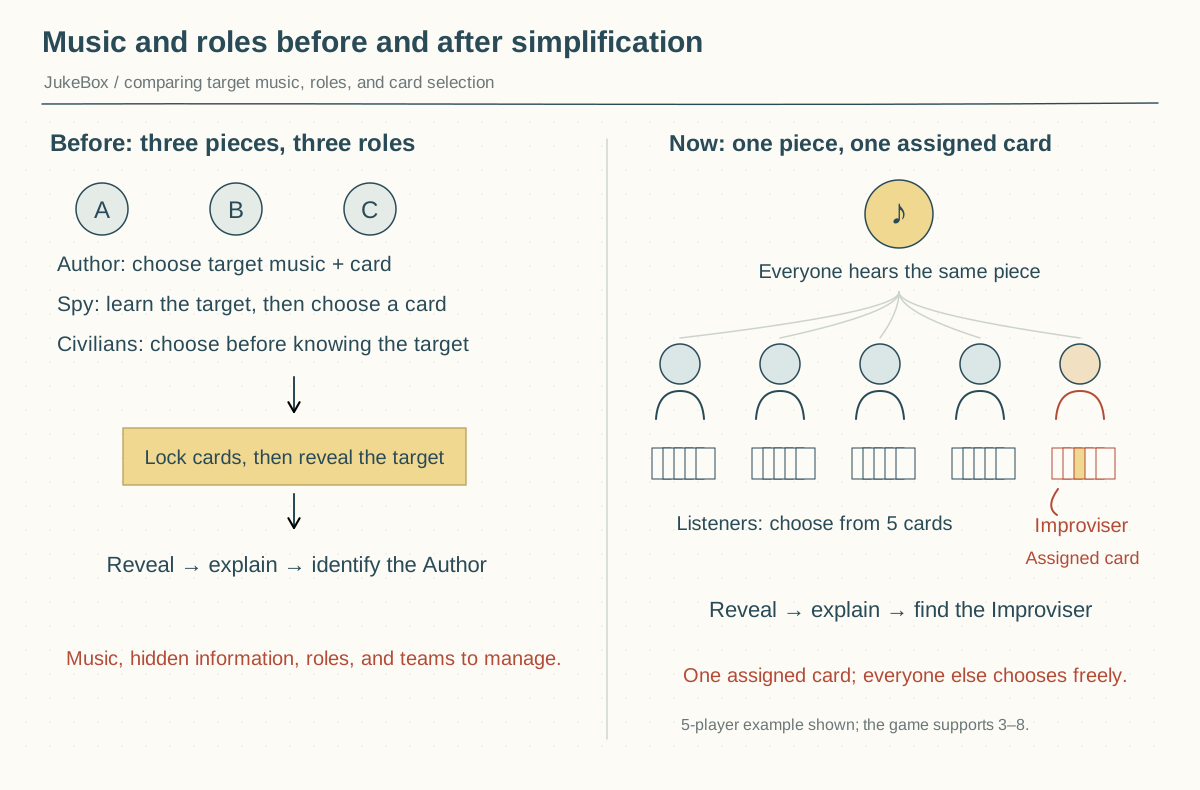
In the basic scoring rules, listeners advance two spaces for a correct accusation. The Improviser advances three spaces if no more than half the listeners identify them; a tie counts as a success. Everyone races around a theater board. The game supports 3–8 players.
I kept the Improviser because an assigned card prompts players to try pictures they would not normally choose. The others also have a reason to listen carefully to the explanation as they try to identify the role.
04The length of the music
During an in-person playtest, the group spent a lot of time listening and much less choosing cards, explaining them, and making judgments. I shortened the excerpts to 10–15 seconds and gave players their cards before playback, so they could look at them while listening.
Shortening the excerpts meant choosing the musical phrases again. Some pieces establish their character quickly; others needed a different starting point to avoid playing only an introduction. The library contains 30 short excerpts, which can be replayed. The tabletop version needs only one device for playback. Everything else uses physical cards and a board.
05Music and artwork
Several testers suggested adding rock or pop music, or switching to an anime art style, to reach a wider audience. I brought up the 18xx board games: their railway and stock-market rules are complex and their artwork is plain, yet they have an audience that enjoys them. I felt JukeBox could keep the material I preferred rather than replace classical music because its audience was smaller.
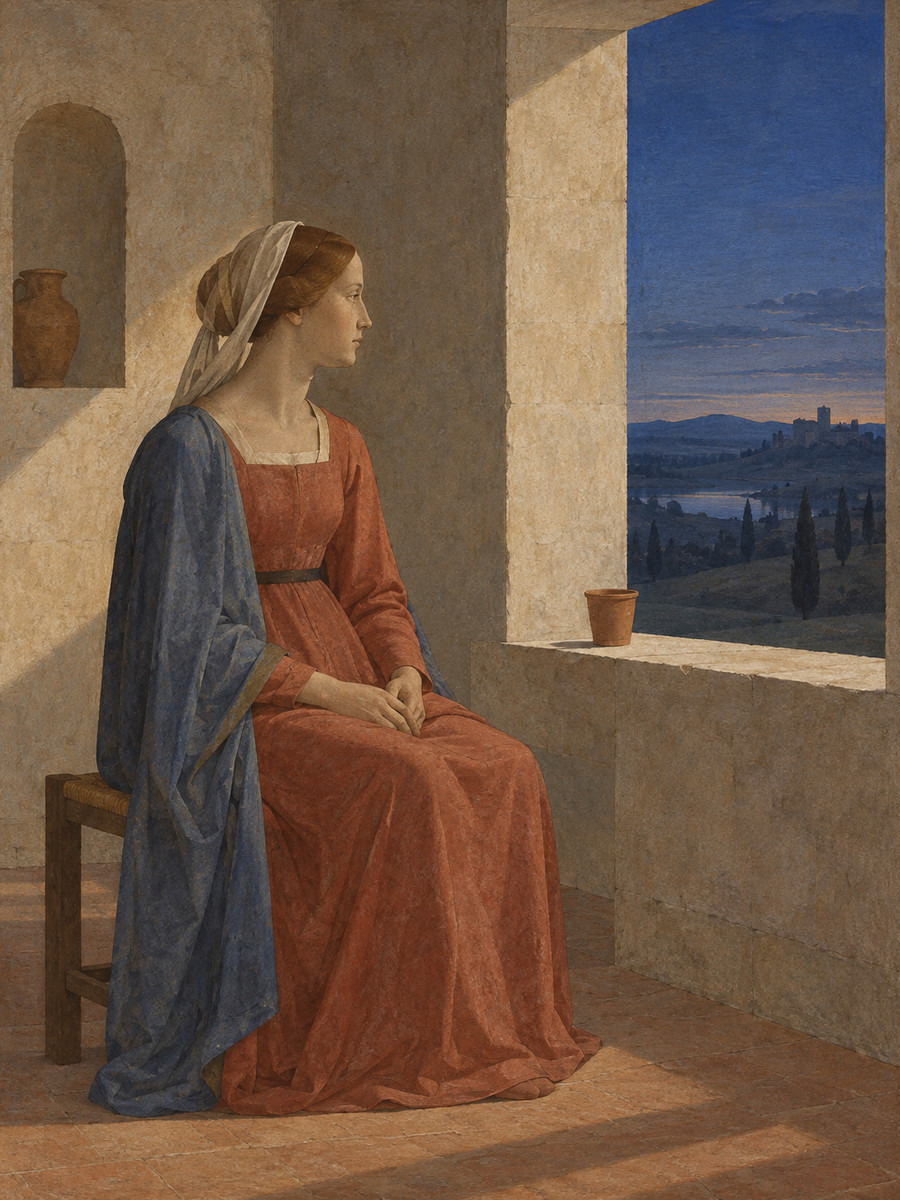
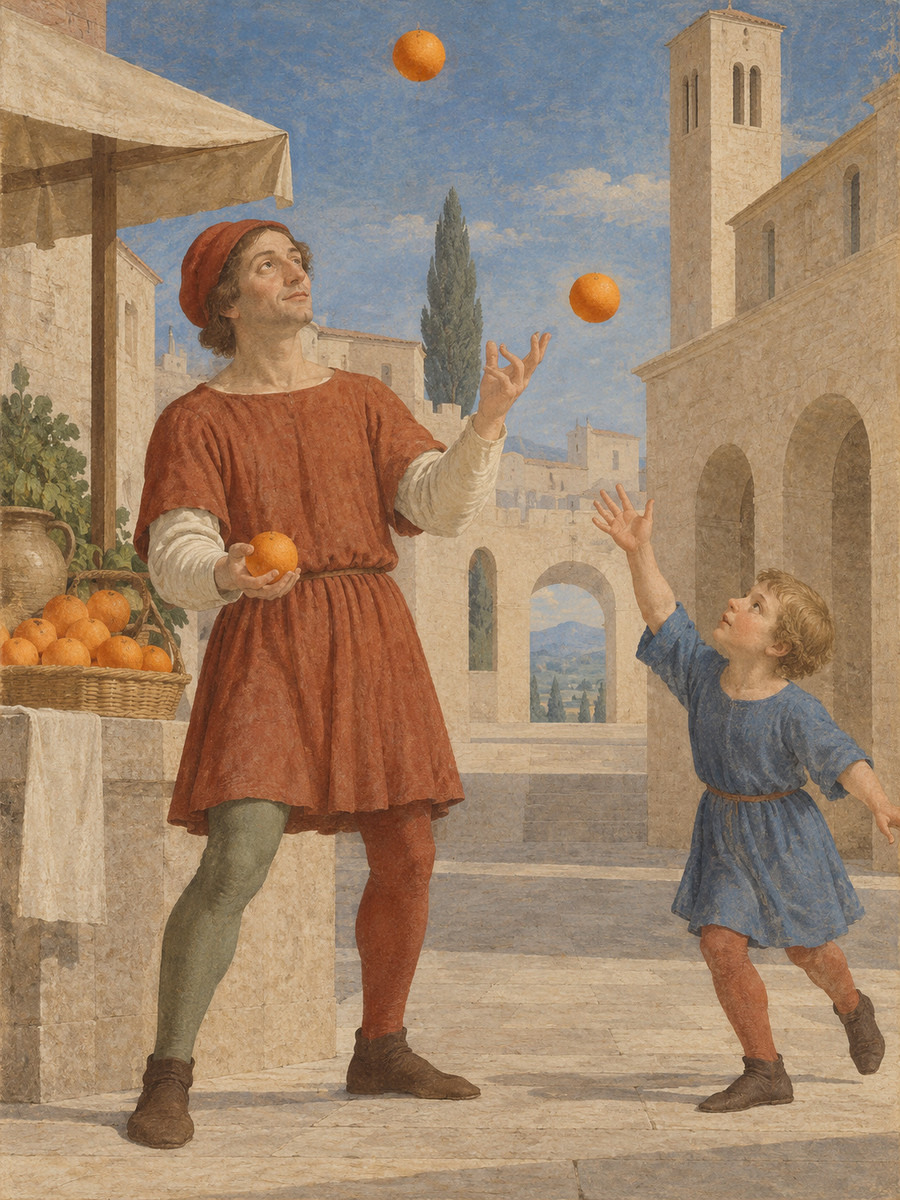
I tried different directions. Lyrics tended to draw associations toward the literal meaning of the words, while a mix of art styles made the cards feel inconsistent together. I kept the combination of classical music and Renaissance painting. The style of the 65 illustrations draws on the work of Piero della Francesca.
The pictures need distinct actions, emotions, and relationships. If a picture fits almost any piece of music, choosing it requires very little thought. I also left room for different interpretations: someone waiting alone, for instance, might suggest loneliness or peace.
06Different interpretations in play
In an early five-player test, one person's choices puzzled the other four. Moonlight, for example, made him think of soldiers. I initially worried that associations so different from everyone else's would reduce role identification to random guessing.
After a few rounds, the others became familiar with how he chose and explained his cards, and could use that to judge his role. He had not changed his associations, and we did not necessarily agree with his explanations, but we could recognize patterns across rounds.
We still interpret music differently, but we can nevertheless develop a considerable understanding of one another. That was the inspiration for this game and what I wanted to make possible through its design.
01灵感来源
多年前,我和朋友聊到德彪西的《月光》和贝多芬的《月光奏鸣曲》:哪一首听起来更像月光?她选德彪西,因为“贝多芬的听起来像是半夜有人在砸你家的门”。但我听贝多芬时,想到的是一个人晚上站在栏杆旁,沉默地看着月光像平静的水一样流淌。
同一段音乐会让人想到完全不同的画面。我想把这种交流做成游戏,让大家选一张图片,解释自己为什么会想到它,再听听其他人的理解。
JukeBox 的玩法是听音乐、选插画、解释两者的联系。大多数玩家可以自由选牌,只有一人必须使用指定牌,又不能让别人发现。
02早期的身份与胜负规则
最早的原型有五个人,一名作者、一名间谍、三名平民,每人五张插画。作者和平民是同一阵营,和间谍对抗。
大家先听三段音乐。作者秘密选定目标音乐和自己的插画;间谍知道目标后选牌;平民不知道目标,先选一张。等所有人选好,再公布目标音乐、亮牌、解释,最后猜人的身份。
作者与间谍知道音乐后挑图,平民则需要为已经选好的图片找联系。我原本希望这个差别能产生有趣的解释,但胜负条件很难处理。
我把一轮可能的结果列出来:平民投给作者、间谍或另一名平民,是三种情况;间谍猜中或猜错作者,是两种。交叉起来有六格。如果每格只能判好人胜或间谍胜,就有 2⁶,也就是 64 种组合。我比较过不同的分配方式,也考虑过平局,想让每个身份都有理由认真参与。
其中一版规定:平民投给作者或另一名平民,同时间谍猜错作者,好人都能赢。图里标出了这两种结果。
这意味着作者可以故意选一张不那么贴切的图,让自己看起来像平民。平民也不必认出作者:只要没有投给间谍,间谍又猜错,好人仍然获胜。这个漏洞是在推演规则时发现的,胜负条件反而鼓励玩家把解释说得含糊一些。
作者的动机还有一个矛盾:他希望平民认出自己,但间谍也能听到相同的解释。线索越清楚,就越容易同时帮助队友和对手。
03简化身份与计分
我先尝试从阵营胜负转向个人计分。一版方案让作者通过被平民认出、找出间谍得分;间谍争取被认成作者,同时避开作者的判断;平民也可以靠临场解释,让作者误以为自己事先知道目标。
个人计分方便分别调整各身份的得分,却增加了需要记住的条件。有些方案里,平民和间谍都在冒充作者,两种身份的玩法越来越相似。
我做这个游戏,最初是想听一个人解释自己听到了什么画面。我不想让复杂的身份和计分占用太多注意力,所以决定做减法,取消作者和三选一的目标音乐,让规则集中在选牌和解释上。
现在每轮只有一段音乐,所有人都知道。大多数人从五张手牌里任选一张,只有一位秘密的即兴创作者必须打出指定牌。听完解释,大家找出那个不能自由选牌的人。
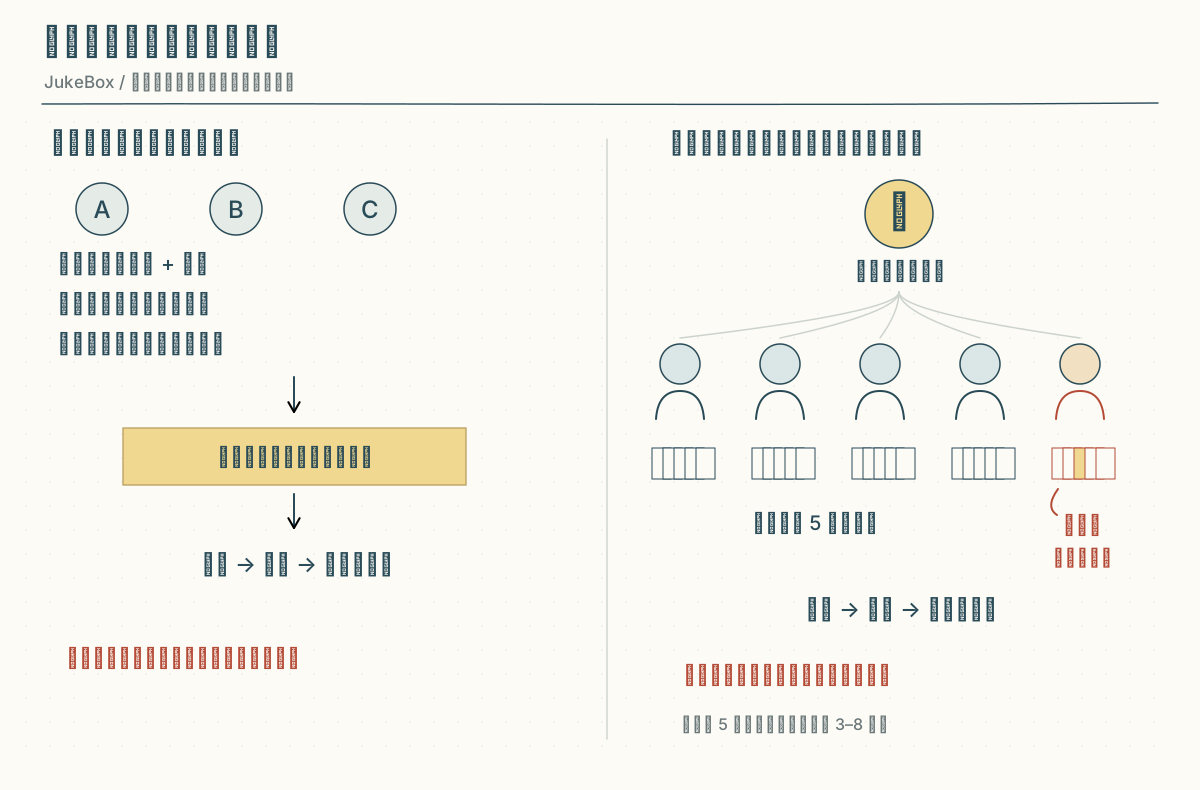
基础计分规则是:听众指认正确前进两步;即兴创作者没有被超过半数听众识破,就前进三步,平票也算成功。所有人在剧院地图上赛跑,游戏支持 3–8 人。
我保留了即兴创作者这个身份,因为指定牌会让玩家尝试原本不会选择的图片。其他人为了判断身份,也需要认真听他的解释。
04音乐片段的长度
一次线下试玩中,大家花了很多时间听音乐,用来选牌、解释和判断的时间却很短。我把片段缩短到 10–15 秒,也让大家在播放前就拿到手牌,可以边听边看。
剪短时需要重新选乐句。有些曲子很快就能听出特点,有些需要换一个截取位置,避免只听到开头的铺垫。曲库有 30 段短音乐,可以重播。线下版只需要一台设备负责播放,其余操作使用实体卡牌和棋盘。
05音乐与美术选择
几位测试者建议加入摇滚、流行音乐,或者换成动漫画风,理由是受众会更广。我当时拿 18xx 桌游举例:它的铁路和股票规则复杂、美术朴素,仍然有喜欢它的玩家。我认为 JukeBox 也可以保留自己偏好的题材,不必因为古典音乐受众较窄就换掉它。
我比较过不同方向。有歌词的片段容易把联想带向歌词中的具体意思;混合几种画风,也让我觉得卡牌放在一起不协调。最后保留了古典音乐与文艺复兴绘画的组合,65 张插画的风格参考了 Piero della Francesca 的作品。
图片需要有明确的动作、情绪和人物关系。如果一张图几乎能搭配任何音乐,玩家就不太需要选择。我也保留了不同解释的空间,例如独自等候既可以是孤独,也可以是安宁。
06试玩中的不同联想
早期一次五人试玩中,有位玩家的选牌让另外四个人很困惑。例如听到《月光》,他想到的是士兵。我起初担心,这种与其他人差别很大的联想会让身份判断变成随机猜测。
几轮以后,其他人开始熟悉他的选牌和解释方式,也能据此判断身份了。他没有改变自己的联想,我们也不一定认同他的解释,但已经能在几轮之间找到一些规律。
我们之间对音乐的解读依然有分歧,但仍然可以达成相当程度的默契,这正是我灵感的来源和设计这个游戏的初衷。