01Inspiration
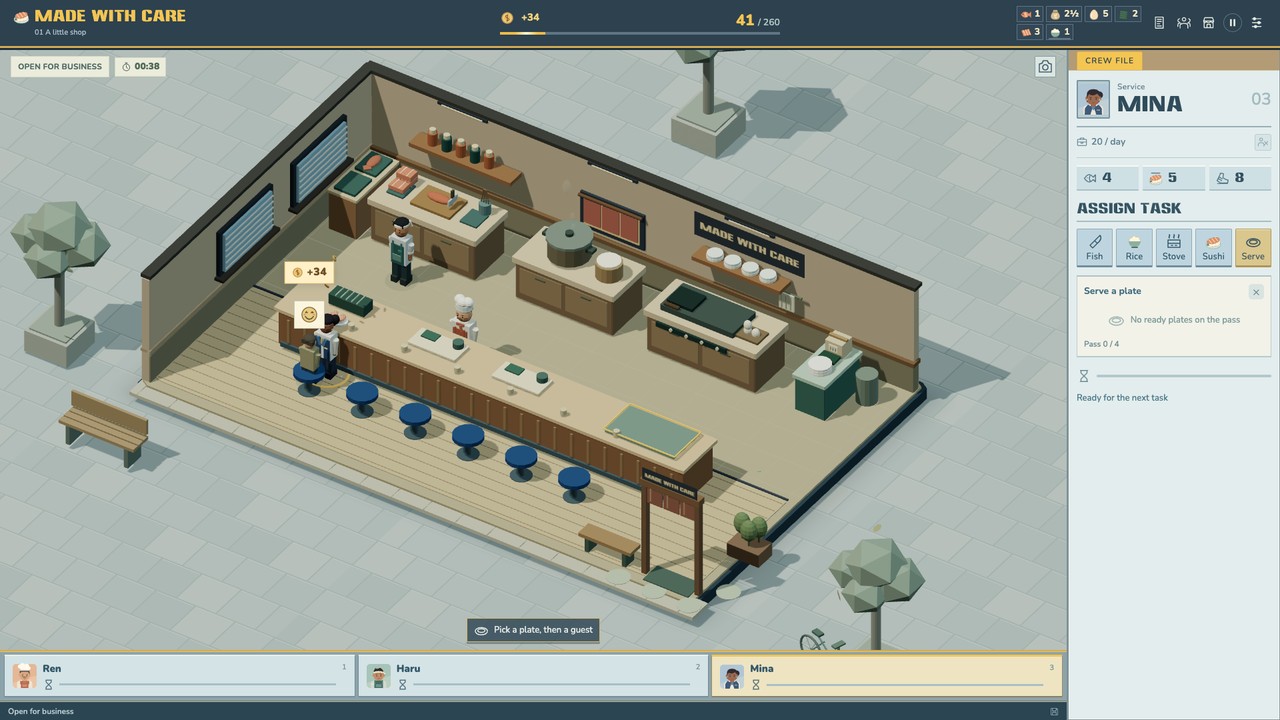
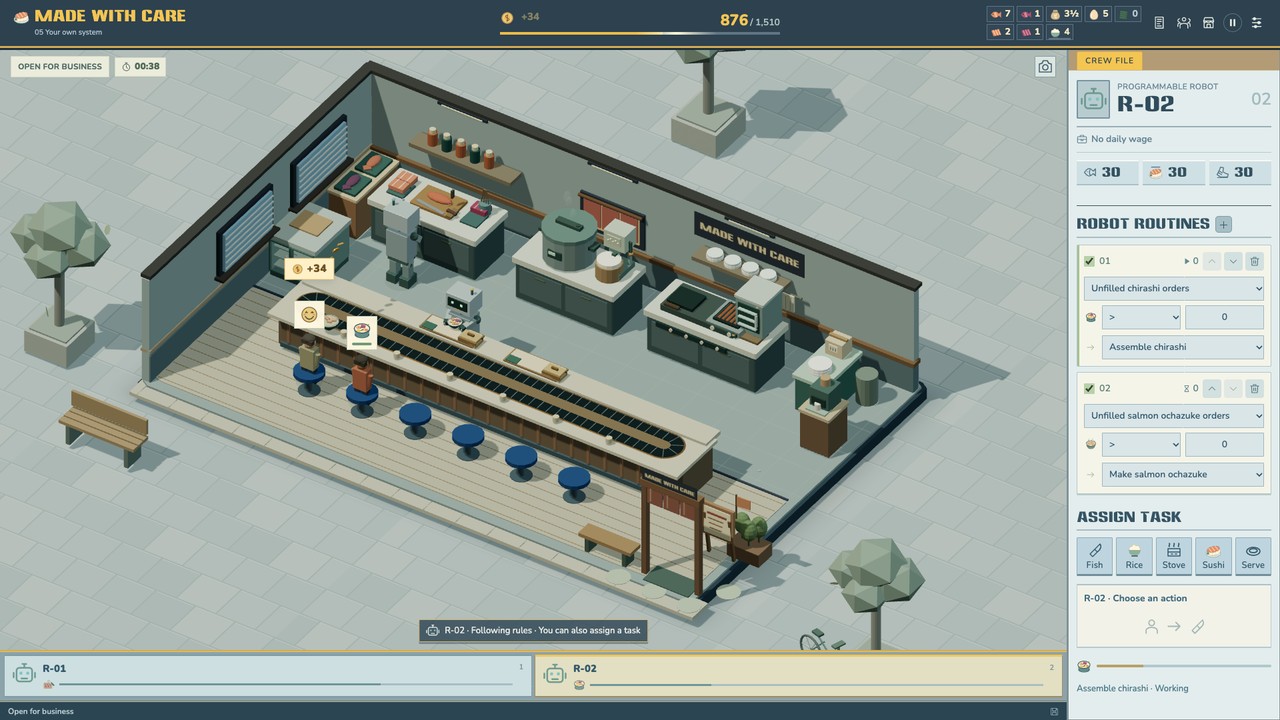
Made With Care is a five-chapter sushi restaurant management game. At first, you assign staff to slice fish, cook rice, prepare dishes, and serve customers. By the end, you can set priorities for robots and let the kitchen and conveyor belt run automatically.
The idea came from my experience developing customer service systems. I saw the work move from local teams in the United States to overseas contractors, then gradually to chatbots. The tools kept improving while the people who had provided the service left in successive waves.
I chose a sushi restaurant because the staff's work can be shown directly. Players recruit people, divide up tasks, and learn the preparation and service routine before deciding whether to replace those employees with machines. The name “Made With Care” contrasts with the increasingly automated service.
02How a day works
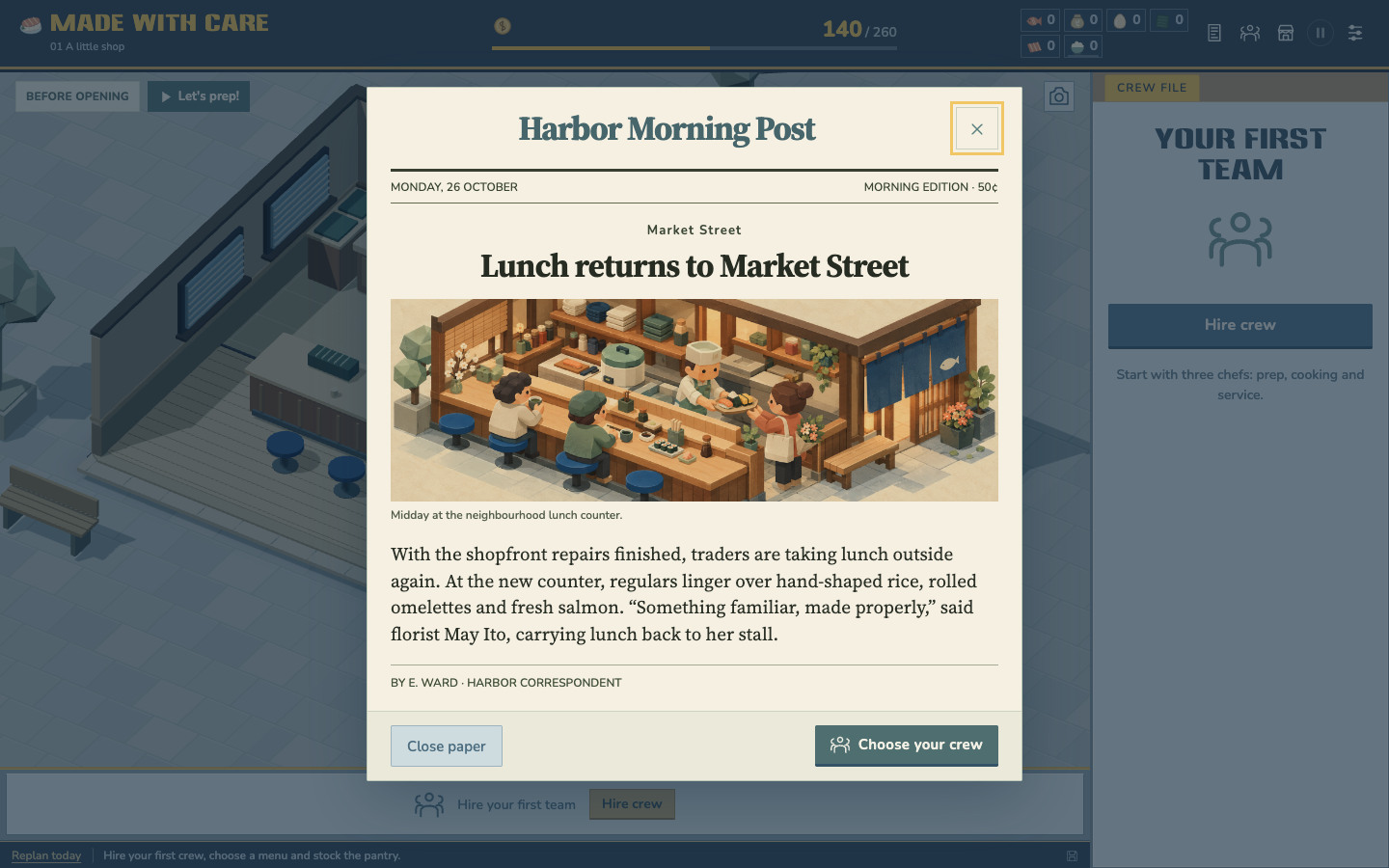
Each day begins with a newspaper. Its stories suggest recent food preferences, such as tuna coming into season, while the supply page estimates customer numbers. Players use this information to choose a menu, hire staff, and buy ingredients and equipment. They then have 30 seconds to prepare before opening. During service, they assign staff to cook and deliver orders placed by seated customers.
The news relates to newly unlocked recipes but does not list each customer's order in advance. Players still have to estimate how much to buy. I also rewrote the newspaper itself. Early articles directly said that new dishes would increase revenue or new employees could help, which did not sound like news. I changed these to neighborhood reports about local lunches and gatherings that suggest what people might want to eat.
03Adjusting the second level
The second level was originally much harder than the first. Buying equipment made processing faster, but players could not operate the controls any faster. They still could not keep up.
Whenever a worker finishes a job, the player needs to assign another. Finding the employee, checking the orders, and choosing an action all take time. Faster processing can also mean having to give new instructions more frequently. Equipment output alone does not account for that work.
I added the rate of task assignment to the simulation. All employees shared one input interval, allowing at most one instruction every 2, 3, 4, or 5 seconds. Selecting an employee and assigning a task both counted as part of that instruction. In level two of the early three-level version, 16 customers arrived over 99 seconds. Even with all the equipment, assigning a task every 4 seconds served only 10 customers and left 318 in cash, below the target of 400. One instruction every 2 seconds served everyone.
For this adjustment, I kept the 16 customers, staff, purchases, and target, but extended the span between the first and last arrival from 99 to 160 seconds. I standardized patience at 95 seconds across ordinary levels, removing the second level's shorter 40-second allowance. Preparation still felt rushed in play, so I then increased the preparation period across all levels from 20 to 30 seconds.
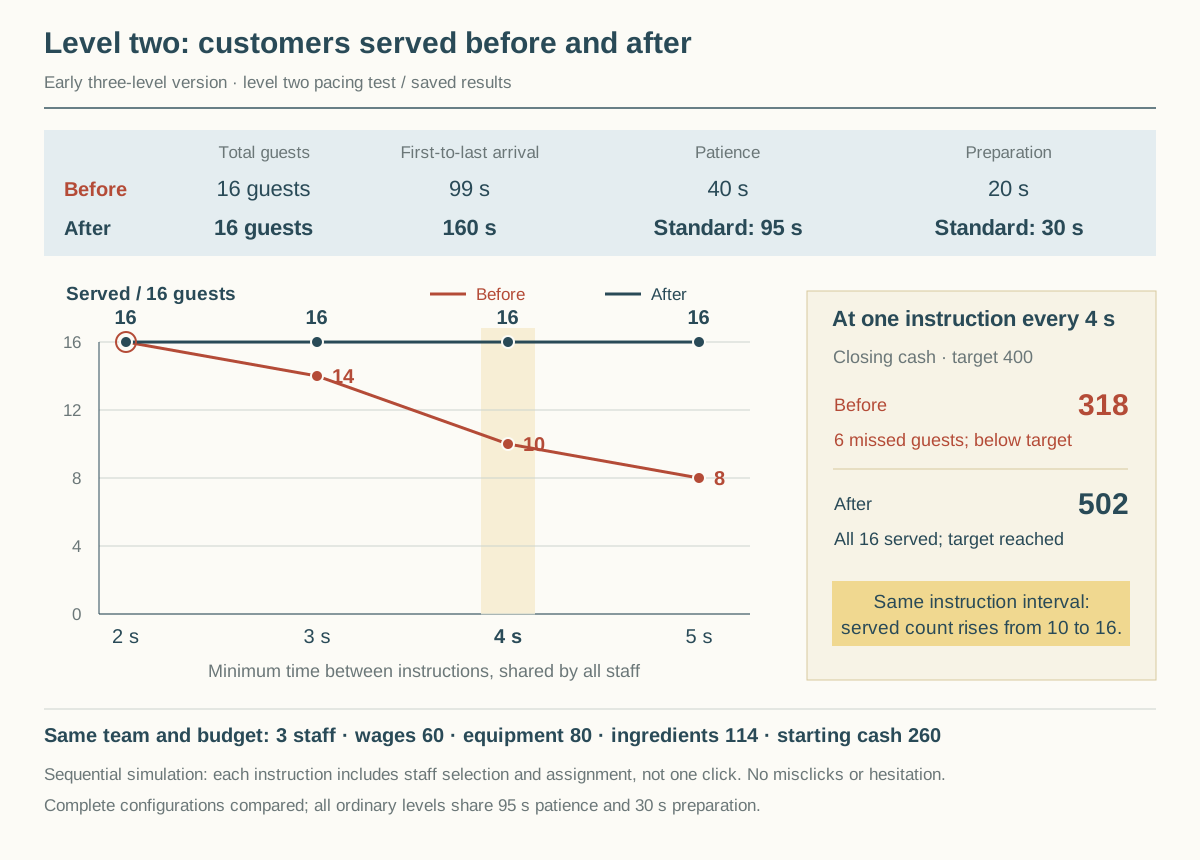
After the changes, one instruction every 4 seconds served all 16 customers and left 502 in cash. A 5-second interval also passed. In the same test, arrival spans from 150 to 190 seconds all allowed every customer to be served. I chose 160 seconds for this revision to keep the day short while allowing full service.
| Setup | Command interval | Served | Cash | Target | Result |
|---|---|---|---|---|---|
| Before | 2 s | 16/16 | 502 | 400 | Pass |
| Before | 3 s | 14/16 | 442 | 400 | Pass |
| Before | 4 s | 10/16 | 318 | 400 | Fail |
| Before | 5 s | 8/16 | 254 | 400 | Fail |
| After | 2 s | 16/16 | 502 | 400 | Pass |
| After | 3 s | 16/16 | 502 | 400 | Pass |
| After | 4 s | 16/16 | 502 | 400 | Pass |
| After | 5 s | 16/16 | 502 | 400 | Pass |
Original test output
┌─────────┬──────────────────────────────┬───────────────────────┬─────────┬──────┬──────┬───────┬──────────────┬──────────┬───────────────────────┐
│ (index) │ scenario                     │ secondsPerInstruction │ served  │ cash │ goal │ won   │ instructions │ duration │ instructionsPerMinute │
├─────────┼──────────────────────────────┼───────────────────────┼─────────┼──────┼──────┼───────┼──────────────┼──────────┼───────────────────────┤
│ 0       │ 'Day 1 current'              │ 2                     │ '12/12' │ 360  │ 260  │ true  │ 32           │ 194.8    │ 9.9                   │
│ 1       │ 'Day 1 current'              │ 3                     │ '12/12' │ 360  │ 260  │ true  │ 32           │ 198.5    │ 9.7                   │
│ 2       │ 'Day 1 current'              │ 4                     │ '12/12' │ 360  │ 260  │ true  │ 32           │ 199.7    │ 9.6                   │
│ 3       │ 'Day 1 current'              │ 5                     │ '11/12' │ 328  │ 260  │ true  │ 32           │ 208.7    │ 9.2                   │
│ 4       │ 'Day 2 before, machines'     │ 2                     │ '16/16' │ 502  │ 400  │ true  │ 43           │ 145.7    │ 17.7                  │
│ 5       │ 'Day 2 before, machines'     │ 3                     │ '14/16' │ 442  │ 400  │ true  │ 43           │ 151.7    │ 17                    │
│ 6       │ 'Day 2 before, machines'     │ 4                     │ '10/16' │ 318  │ 400  │ false │ 38           │ 158.9    │ 14.3                  │
│ 7       │ 'Day 2 before, machines'     │ 5                     │ '8/16'  │ 254  │ 400  │ false │ 29           │ 153.8    │ 11.3                  │
│ 8       │ 'Day 2 before, no machines'  │ 2                     │ '8/16'  │ 330  │ 400  │ false │ 28           │ 155.1    │ 10.8                  │
│ 9       │ 'Day 2 before, no machines'  │ 3                     │ '6/16'  │ 268  │ 400  │ false │ 28           │ 158      │ 10.6                  │
│ 10      │ 'Day 2 before, no machines'  │ 4                     │ '5/16'  │ 242  │ 400  │ false │ 26           │ 159      │ 9.8                   │
│ 11      │ 'Day 2 before, no machines'  │ 5                     │ '5/16'  │ 242  │ 400  │ false │ 21           │ 159      │ 7.9                   │
│ 12      │ 'Day 2 current, machines'    │ 2                     │ '16/16' │ 502  │ 400  │ true  │ 43           │ 209.7    │ 12.3                  │
│ 13      │ 'Day 2 current, machines'    │ 3                     │ '16/16' │ 502  │ 400  │ true  │ 43           │ 207      │ 12.5                  │
│ 14      │ 'Day 2 current, machines'    │ 4                     │ '16/16' │ 502  │ 400  │ true  │ 43           │ 206.8    │ 12.5                  │
│ 15      │ 'Day 2 current, machines'    │ 5                     │ '16/16' │ 502  │ 400  │ true  │ 43           │ 249.7    │ 10.3                  │
│ 16      │ 'Day 2 current, no machines' │ 2                     │ '16/16' │ 582  │ 400  │ true  │ 43           │ 271.4    │ 9.5                   │
│ 17      │ 'Day 2 current, no machines' │ 3                     │ '15/16' │ 550  │ 400  │ true  │ 43           │ 274.9    │ 9.4                   │
│ 18      │ 'Day 2 current, no machines' │ 4                     │ '15/16' │ 550  │ 400  │ true  │ 42           │ 274.2    │ 9.2                   │
│ 19      │ 'Day 2 current, no machines' │ 5                     │ '12/16' │ 458  │ 400  │ true  │ 37           │ 285      │ 7.8                   │
└─────────┴──────────────────────────────┴───────────────────────┴─────────┴──────┴──────┴───────┴──────────────┴──────────┴───────────────────────┘
Download record
Slower arrivals also changed how necessary equipment was. In the same simulation, buying no equipment and assigning a task every 5 seconds served only 12 of 16 customers, but still left 458, above the 400 target. I kept this option, allowing players to pass through task planning and savings on equipment.
04Batch preparation
Fish slicing originally produced exactly 2 slices per task. I changed it to a selectable quantity, with a maximum of 4 after upgrading the knife. Rice changed from a fixed batch of 4 portions to a maximum of 2. Larger fish batches reduce repeated instructions; smaller rice batches make it easier to control preparation quantities and storage use.
With Haru and the upgraded knife, 2 slices take about 6.15 seconds and 4 take about 12.31 seconds, counting processing only, not walking. Two batches of 2 and one batch of 4 take the same total processing time. The difference is that the player does not have to assign another task halfway through. Tests checked batch limits, duration, material use, and storage occupancy.
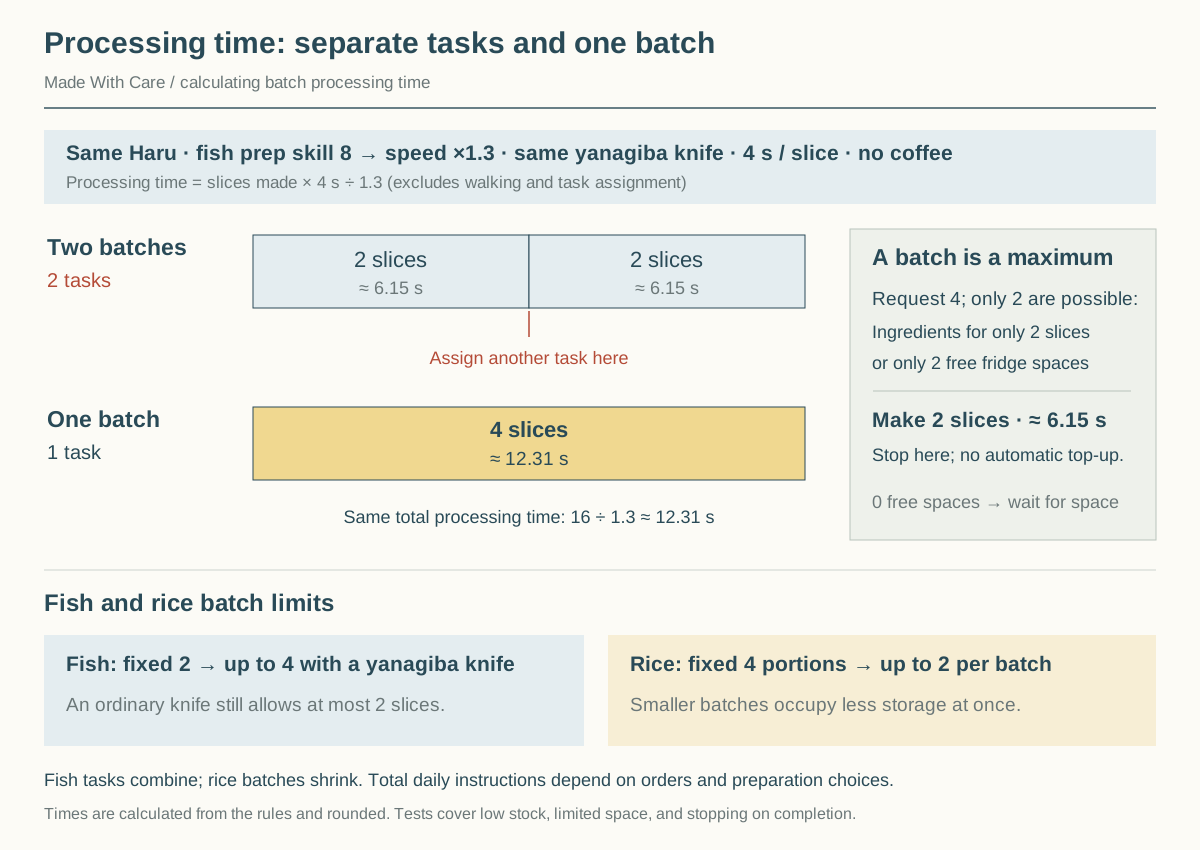
Batching had another problem: if the player requested 4 slices but only had enough ingredients for 2, the employee did nothing. I changed it to process as much as possible. If the fridge has only 2 spaces left, the worker makes 2 slices. Players no longer need to calculate the remaining space and then edit the instruction themselves.
Original test output
# Subtest: batch limits describe final outputs rather than ingredient package multipliers
ok 14 - batch limits describe final outputs rather than ingredient package multipliers
  ---
  duration_ms: 0.651917
  type: 'test'
  ...
# Subtest: four fish slices consume exactly two fish and stop after one selected batch
ok 15 - four fish slices consume exactly two fish and stop after one selected batch
  ---
  duration_ms: 9.150542
  type: 'test'
  ...
# Subtest: work time scales by finished portions, then skill and coffee apply
ok 18 - work time scales by finished portions, then skill and coffee apply
  ---
  duration_ms: 2.838584
  type: 'test'
  ...
# Subtest: a batch uses available storage immediately and stops after the clamped quantity
ok 21 - a batch uses available storage immediately and stops after the clamped quantity
  ---
  duration_ms: 17.704875
  type: 'test'
  ...
# Subtest: partial raw stock makes two or three fish slices and one rice portion without topping up later
ok 22 - partial raw stock makes two or three fish slices and one rice portion without topping up later
  ---
  duration_ms: 19.6105
  type: 'test'
  ...
Download record
Customers now arrive in groups, with time to replenish supplies in between. Delivering a dish pays immediately, removing the extra progress bar that previously ran after the food had reached the customer.
Patience and preparation time stay consistent across ordinary levels. Difficulty changes through arrivals, orders, and equipment. To keep each level around five minutes, I had once added a forced closing time, but customers could still be waiting for food when it triggered. I replaced that with adjustments to customer numbers and arrival timing, allowing the final order to finish before closing.
05Recipes and earnings
Even with fewer repetitive inputs, play still largely consisted of checking who was most impatient and deciding what to do first. I added recipes so players could choose different ways to run the restaurant before opening.
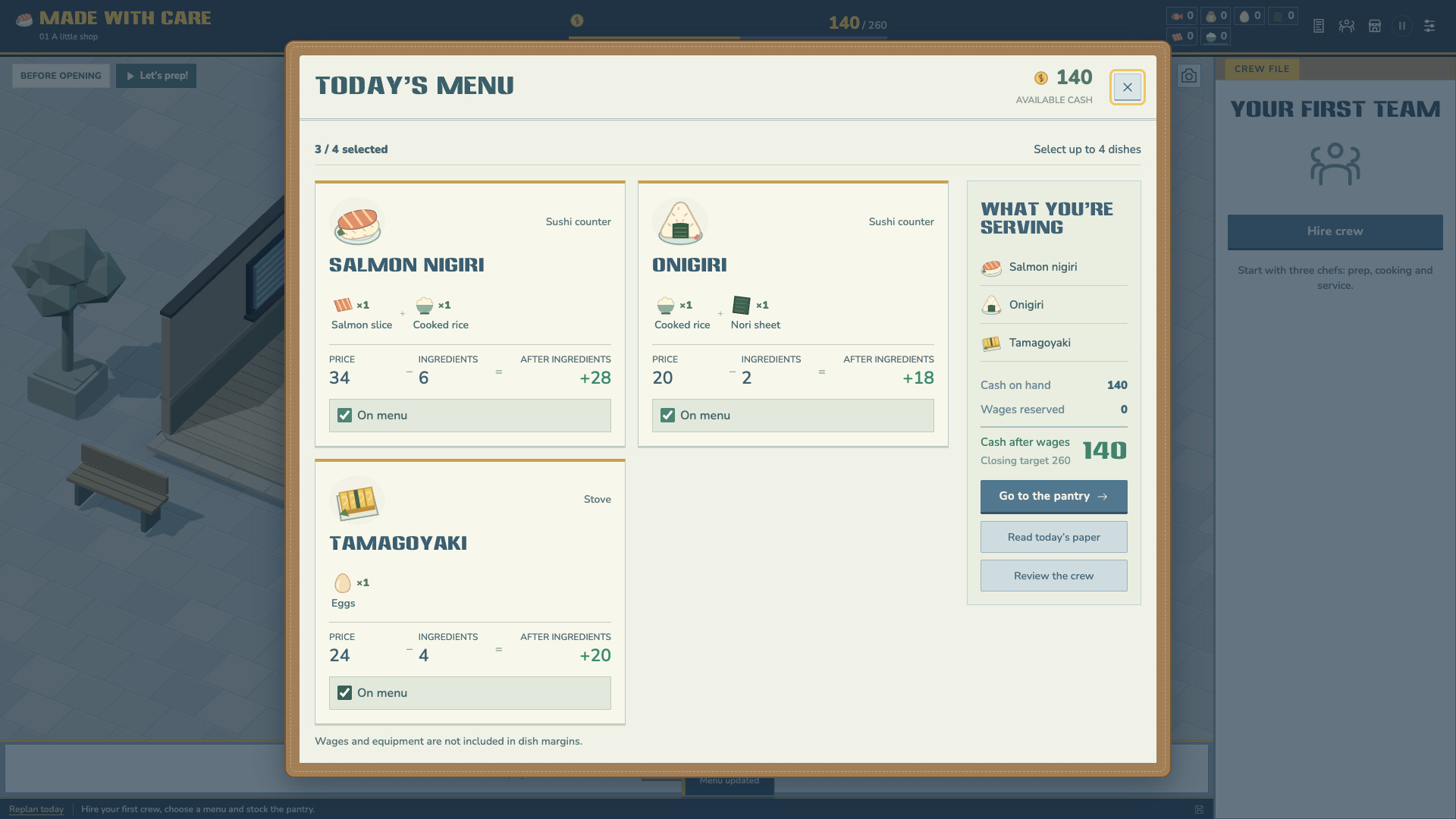
Players select the day's menu from the dishes they have learned. Onigiri needs only rice and nori; chirashi don needs two kinds of fish, rice, and egg, making purchasing and preparation more involved. Recipes unlock directly after passing a level. Players decide whether to add them to the menu.
Dishes that require more types of ingredients and more preparation should earn more per serving. For example, onigiri sells for 20 with an ingredient cost of 2, leaving 18. Chirashi don sells for 84, costs 17 in ingredients, and leaves 67. That difference gives players a reason to prepare more ingredients. It also lets them pass up some ordinary orders to prioritize dishes with a higher return.
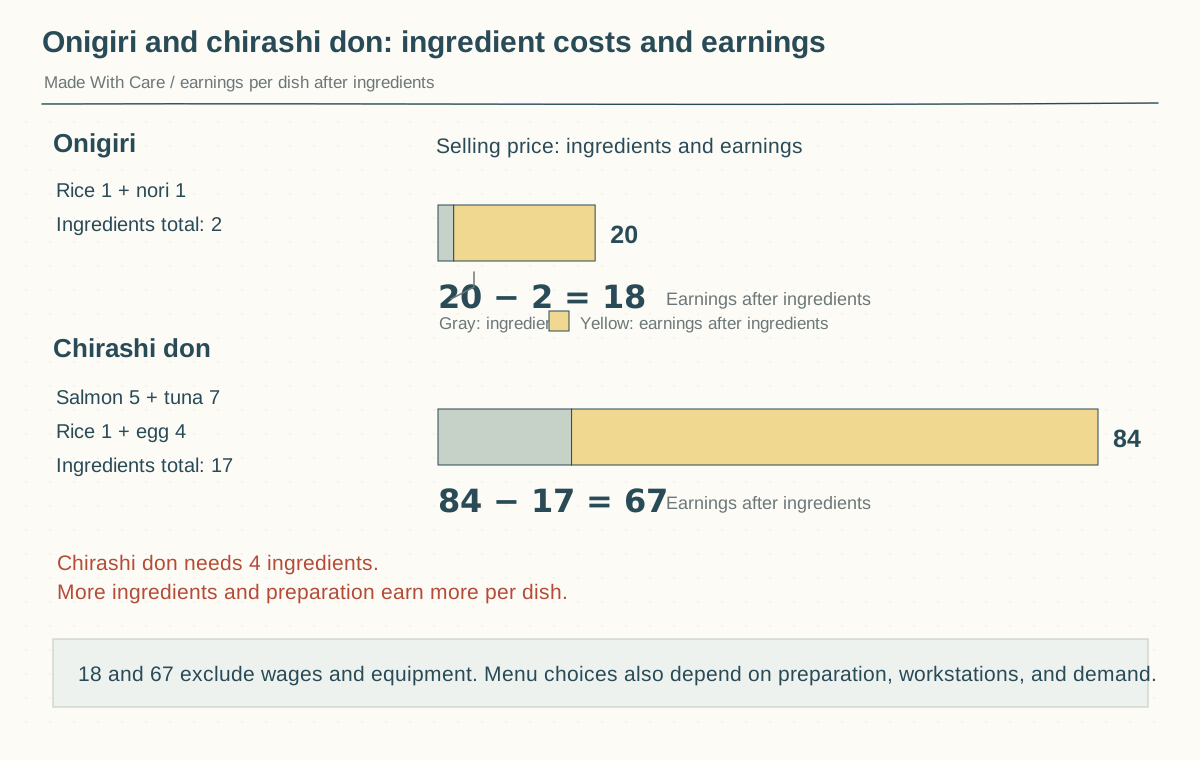
Those figures subtract only ingredients. Wages, equipment, and waste are separate costs. I also relaxed the original target calibration, which allowed three missed customers but not four, to accommodate different menus and business strategies. Savings from previous days or more high-return orders can compensate for additional missed customers.
I revised the accounting too. The test version had left too much starting cash, and money remaining after buying ingredients was not fully counted toward the target. I changed it to provide funding only once, at the start. Each day's target is then checked against the previous balance plus sales revenue, minus ingredients, equipment, and wages. I reduced purchasing warnings as well: buying fewer ingredients may be an intentional decision to serve only certain dishes.
06Equipment and robots
The original three chapters represented the early, middle, and late stages. Expanding to five allowed more gradual equipment upgrades: better knives first, then rice cookers, ovens, steam cabinets, and commercial machines.
In one version, upgraded equipment sliced fish and cooked by itself, with names and shapes that did not resemble actual kitchen equipment. I replaced these with more familiar tools that increase batch size or speed but still require an employee to operate them. The player decides what to replenish and which dish to make first. Later, robots can make those decisions by following rules.
Robot priorities run from top to bottom. For example: serve a finished dish if one is available, cook when there is an order, and replenish ingredients when needed. Players can change the conditions, quantities, and order. The conveyor belt only transports completed dishes. By day five, the player's main tasks are adjusting rules and checking how the system runs.
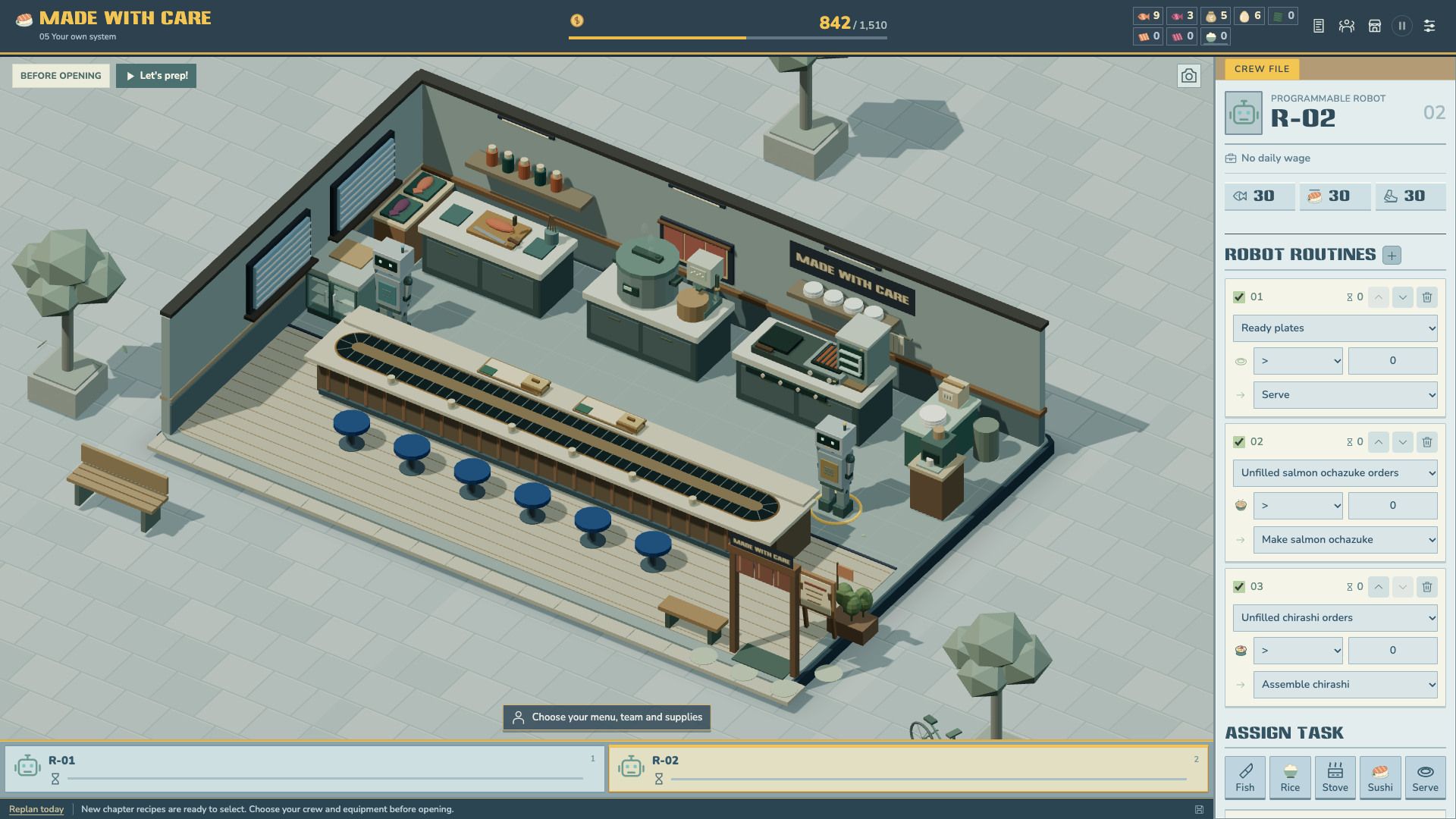
The game originally started with three employees. I changed it so players must hire first. Candidates have different specialties, abilities, and wages, requiring players to divide the work according to their budget and menu. Replacing them with robots later also means opening the staff page and dismissing the original employees manually. I kept that step so replacing staff remains the player's own decision.
07Art, music, and interface
Day one uses warm wood, paper, and leather details. Later kitchens gradually introduce cooler colors and more metal. Early music centers on relaxed piano and saxophone; later tracks become more mechanical as the equipment and workforce change.
Raw ingredients and prepared food sit together in the top bar, so players do not need to keep opening the inventory during service. Earlier versions had a dense background that distracted attention from the restaurant. I removed the background houses and enlarged the restaurant to make the staff, food, and customer actions easier to see.
01灵感来源
Made With Care 是一款五章的寿司店经营游戏。开店时,玩家要安排员工切鱼、煮饭、做菜、送餐;到了最后,可以给机器人设定优先级,让厨房与传送带自动运转。
这个想法来自我参与客服系统开发的经历。我看到客服工作从美国本地团队转向国外的外包团队,再逐渐交给聊天机器人。工具不断升级,原本负责服务的人却一批批离开。
我选择寿司店作为游戏场景,是因为员工的工作可以直接展示出来。玩家先招聘、分工,熟悉备料和出餐的过程,之后再决定是否用机器替换这些员工。游戏名“Made With Care”与逐渐自动化的服务形成反差。
02玩法流程
每天先读报。新闻暗示近期的饮食偏好,比如金枪鱼上市;采购页给出大致客流。玩家据此选菜单、雇人、买材料和设备,随后有 30 秒备菜时间。营业后,要根据已入座客人的订单,安排员工制作和送餐。
新闻会配合新解锁的菜谱,但不会提前列出每位客人的订单,采购量仍然需要玩家估计。报纸的文字也改过:原来的文章直接说“新菜能提高收益”“新员工能帮忙”,不像新闻。后来改成街区报道,通过当地人的午餐和聚会介绍饮食偏好。
03第二关的难度调整
第二关原本比第一关难很多。买了设备以后加工速度快了,但玩家的操作并没有更快,所以还是来不及。
员工完成工作后,需要玩家继续派任务。玩家要找到员工、查看订单、选择动作,加工速度越快,需要重新派工的频率也可能越高。只计算设备产量,无法反映这些操作所需的时间。
我把派工速度也放进模拟:全体员工共用一个输入间隔,每隔 2、3、4 或 5 秒,最多发出一条指令。选人、选动作都算在这条指令里。在早期三关版本的第二关,16 位顾客在 99 秒内陆续到店。即使买齐设备,每隔 4 秒派一次工,也只能接待 10 人,结余 318,达不到 400 的目标;每隔 2 秒派工则能全部接待。
这轮调整保留了 16 位顾客、相同的员工、采购和过关目标,把首末两位顾客的到店跨度从 99 秒拉到 160 秒。普通关卡的耐心统一为 95 秒,取消第二关原先只有 40 秒的差别。随后,因为试玩时备料仍然太赶,我又把各关备菜时间从 20 秒加到 30 秒。
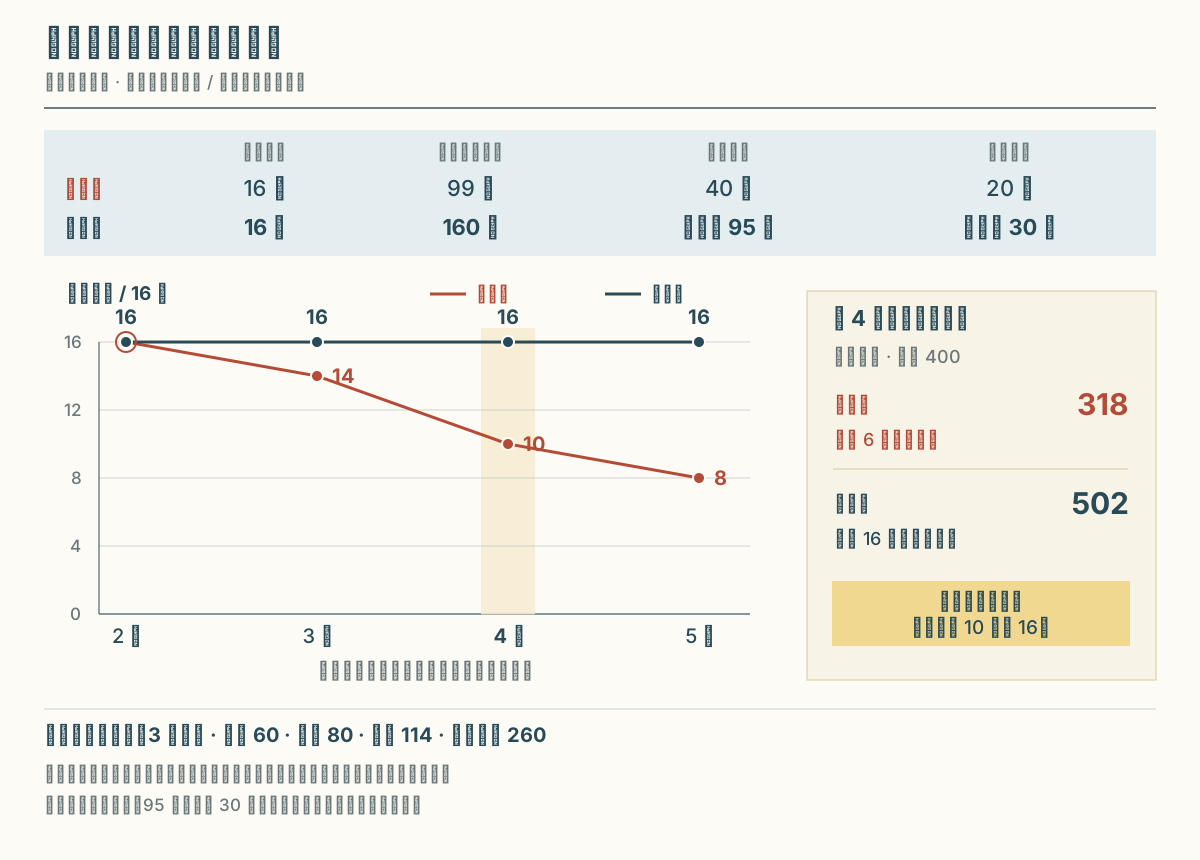
调整后,每隔 4 秒派工能接待全部 16 人,结余 502;每隔 5 秒派工也能过关。同样的测试中,150–190 秒的客流跨度都能接满顾客。这一轮选择 160 秒,在保证接待数量的同时,控制营业时长。
| 配置 | 派工间隔 | 接待 | 结余 | 目标 | 结果 |
|---|---|---|---|---|---|
| 调整前 | 2 s | 16/16 | 502 | 400 | 通过 |
| 调整前 | 3 s | 14/16 | 442 | 400 | 通过 |
| 调整前 | 4 s | 10/16 | 318 | 400 | 未通过 |
| 调整前 | 5 s | 8/16 | 254 | 400 | 未通过 |
| 调整后 | 2 s | 16/16 | 502 | 400 | 通过 |
| 调整后 | 3 s | 16/16 | 502 | 400 | 通过 |
| 调整后 | 4 s | 16/16 | 502 | 400 | 通过 |
| 调整后 | 5 s | 16/16 | 502 | 400 | 通过 |
查看原始测试记录
┌─────────┬──────────────────────────────┬───────────────────────┬─────────┬──────┬──────┬───────┬──────────────┬──────────┬───────────────────────┐
│ (index) │ scenario                     │ secondsPerInstruction │ served  │ cash │ goal │ won   │ instructions │ duration │ instructionsPerMinute │
├─────────┼──────────────────────────────┼───────────────────────┼─────────┼──────┼──────┼───────┼──────────────┼──────────┼───────────────────────┤
│ 0       │ 'Day 1 current'              │ 2                     │ '12/12' │ 360  │ 260  │ true  │ 32           │ 194.8    │ 9.9                   │
│ 1       │ 'Day 1 current'              │ 3                     │ '12/12' │ 360  │ 260  │ true  │ 32           │ 198.5    │ 9.7                   │
│ 2       │ 'Day 1 current'              │ 4                     │ '12/12' │ 360  │ 260  │ true  │ 32           │ 199.7    │ 9.6                   │
│ 3       │ 'Day 1 current'              │ 5                     │ '11/12' │ 328  │ 260  │ true  │ 32           │ 208.7    │ 9.2                   │
│ 4       │ 'Day 2 before, machines'     │ 2                     │ '16/16' │ 502  │ 400  │ true  │ 43           │ 145.7    │ 17.7                  │
│ 5       │ 'Day 2 before, machines'     │ 3                     │ '14/16' │ 442  │ 400  │ true  │ 43           │ 151.7    │ 17                    │
│ 6       │ 'Day 2 before, machines'     │ 4                     │ '10/16' │ 318  │ 400  │ false │ 38           │ 158.9    │ 14.3                  │
│ 7       │ 'Day 2 before, machines'     │ 5                     │ '8/16'  │ 254  │ 400  │ false │ 29           │ 153.8    │ 11.3                  │
│ 8       │ 'Day 2 before, no machines'  │ 2                     │ '8/16'  │ 330  │ 400  │ false │ 28           │ 155.1    │ 10.8                  │
│ 9       │ 'Day 2 before, no machines'  │ 3                     │ '6/16'  │ 268  │ 400  │ false │ 28           │ 158      │ 10.6                  │
│ 10      │ 'Day 2 before, no machines'  │ 4                     │ '5/16'  │ 242  │ 400  │ false │ 26           │ 159      │ 9.8                   │
│ 11      │ 'Day 2 before, no machines'  │ 5                     │ '5/16'  │ 242  │ 400  │ false │ 21           │ 159      │ 7.9                   │
│ 12      │ 'Day 2 current, machines'    │ 2                     │ '16/16' │ 502  │ 400  │ true  │ 43           │ 209.7    │ 12.3                  │
│ 13      │ 'Day 2 current, machines'    │ 3                     │ '16/16' │ 502  │ 400  │ true  │ 43           │ 207      │ 12.5                  │
│ 14      │ 'Day 2 current, machines'    │ 4                     │ '16/16' │ 502  │ 400  │ true  │ 43           │ 206.8    │ 12.5                  │
│ 15      │ 'Day 2 current, machines'    │ 5                     │ '16/16' │ 502  │ 400  │ true  │ 43           │ 249.7    │ 10.3                  │
│ 16      │ 'Day 2 current, no machines' │ 2                     │ '16/16' │ 582  │ 400  │ true  │ 43           │ 271.4    │ 9.5                   │
│ 17      │ 'Day 2 current, no machines' │ 3                     │ '15/16' │ 550  │ 400  │ true  │ 43           │ 274.9    │ 9.4                   │
│ 18      │ 'Day 2 current, no machines' │ 4                     │ '15/16' │ 550  │ 400  │ true  │ 42           │ 274.2    │ 9.2                   │
│ 19      │ 'Day 2 current, no machines' │ 5                     │ '12/16' │ 458  │ 400  │ true  │ 37           │ 285      │ 7.8                   │
└─────────┴──────────────────────────────┴───────────────────────┴─────────┴──────┴──────┴───────┴──────────────┴──────────┴───────────────────────┘
下载记录
放缓客流也改变了设备的必要性。同一轮模拟中,不买设备、每隔 5 秒派工,只接待 12/16 位顾客,结余仍有 458,超过 400 的目标。我保留了这条经营路线,让玩家可以通过安排任务和节省设备费过关。
04批量加工
切鱼原来每条任务固定做 2 片,后来改成可以选择份数,升级刀具后最多做 4 片。米饭原来一次固定做 4 份,改成每次最多 2 份。鱼片可以合并任务,减少重复派工;米饭的小批次则方便控制备料量和储存占用。
以 Haru 和升级刀具为例,做 2 片约需 6.15 秒,做 4 片约需 12.31 秒,只计算加工、不算走路。两次做 2 片和一次做 4 片的总加工时间相同,区别是玩家不用中途再派一次工。测试检查了批量上限、耗时、材料消耗和储存占用。
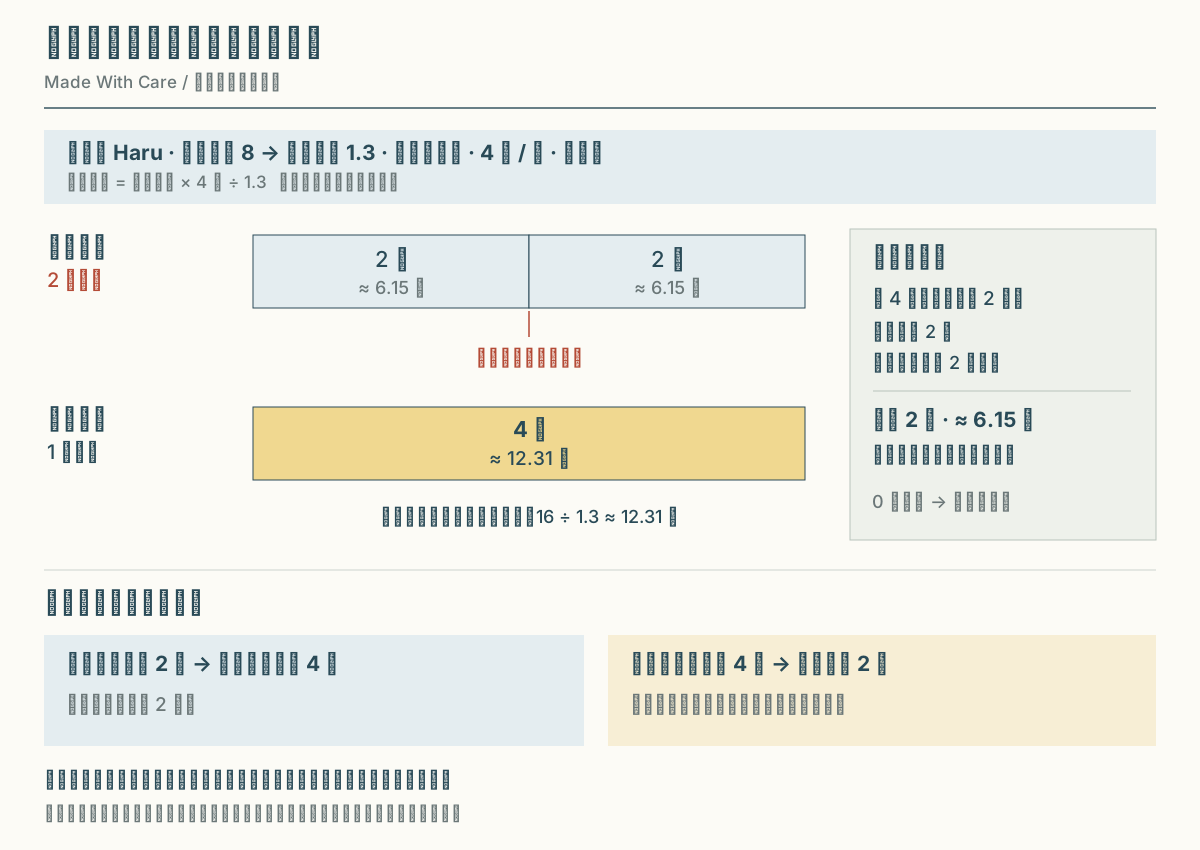
批量还有一个问题:选了 4 片,原料只够 2 片,员工就什么都不做。后来改成先完成能做的部分;冰箱只剩 2 个空位,也只加工 2 片。玩家不用先算出剩余空位,再回去修改指令。
查看原始测试记录
# Subtest: batch limits describe final outputs rather than ingredient package multipliers
ok 14 - batch limits describe final outputs rather than ingredient package multipliers
  ---
  duration_ms: 0.651917
  type: 'test'
  ...
# Subtest: four fish slices consume exactly two fish and stop after one selected batch
ok 15 - four fish slices consume exactly two fish and stop after one selected batch
  ---
  duration_ms: 9.150542
  type: 'test'
  ...
# Subtest: work time scales by finished portions, then skill and coffee apply
ok 18 - work time scales by finished portions, then skill and coffee apply
  ---
  duration_ms: 2.838584
  type: 'test'
  ...
# Subtest: a batch uses available storage immediately and stops after the clamped quantity
ok 21 - a batch uses available storage immediately and stops after the clamped quantity
  ---
  duration_ms: 17.704875
  type: 'test'
  ...
# Subtest: partial raw stock makes two or three fish slices and one rice portion without topping up later
ok 22 - partial raw stock makes two or three fish slices and one rice portion without topping up later
  ---
  duration_ms: 19.6105
  type: 'test'
  ...
下载记录
客流也改成分批到店,中间留出补料时间。餐点送到顾客面前就立刻收钱,删掉了送达后再等一段进度条的步骤。
普通关卡的耐心和备菜时间保持一致,难度通过客流、订单和设备调整。为了让每关在五分钟左右结束,我曾加过到点强制结算,但那时还有客人在等菜。后来改成控制顾客数量和到店节奏,让最后一单自然结束后结算。
05菜谱与收益
减少操作以后,玩法仍然主要是看谁最着急,再决定先做哪件事。我加入菜谱系统,让玩家在开店前就能选择不同的经营方式。
开店前,玩家从已学会的菜里选择当天的菜单。饭团只需要米饭和海苔;散寿司需要两种鱼、米饭和鸡蛋,采购和备料都更复杂。菜谱通过关卡后直接解锁,是否加入菜单由玩家决定。
材料种类越多、准备成本越高的菜,单份收益也应该更高。例如饭团售价 20、材料成本 2,扣除材料后剩 18;散寿司售价 84、材料成本 17,剩 67。这个差距让玩家有理由多准备几种材料,也可以选择放弃一部分普通订单,优先完成高收益菜品。
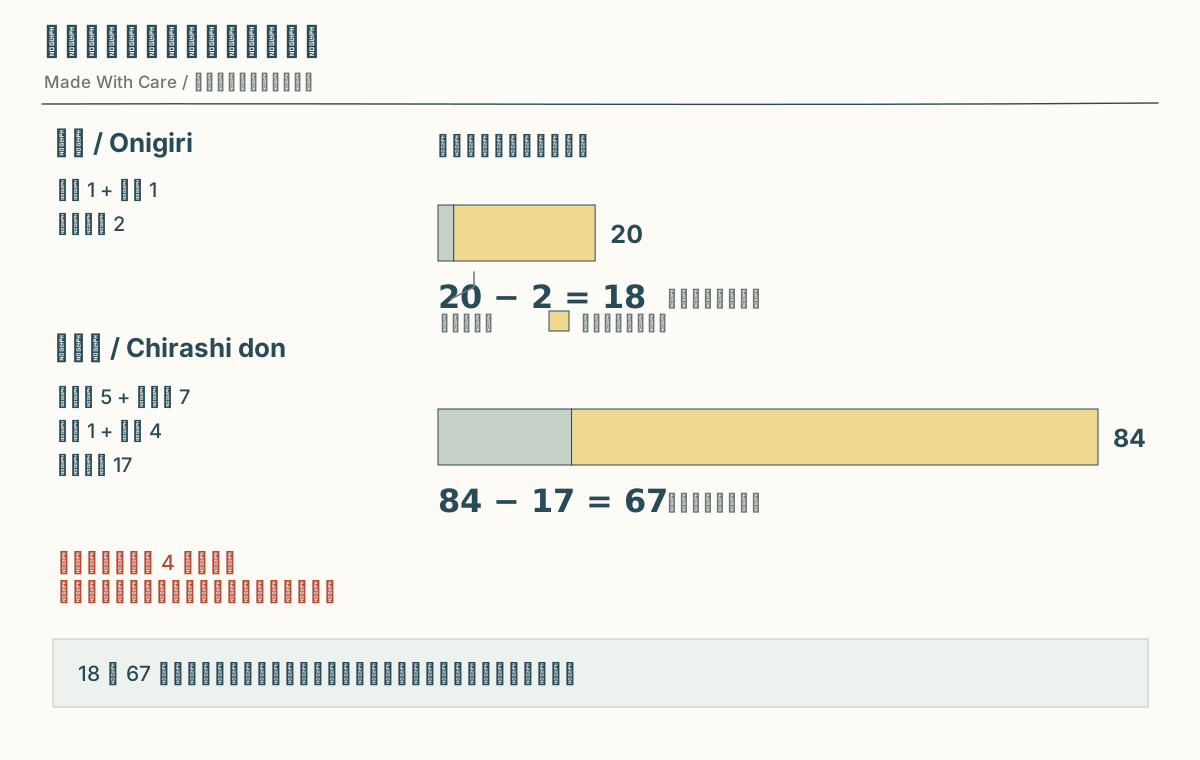
这些数值只扣除了材料,工资、设备和浪费还要另算。最初按“漏掉三位客人仍能过关,四位就不行”校准的目标,也改成允许不同菜单和经营方式。历史积蓄较多,或者完成了更多高收益订单,都能让玩家承受更多漏单。
账目也重新整理过。测试版留下了过多的初始资金,而且买完食材剩下的钱没有完整计入过关目标。我改成只在开局提供一次资金,之后用之前的结余加营业收入,再扣除原料、设备和工资,计算当天是否达标。采购提醒也减少了:材料买得少,可能是玩家有意只做某些菜。
06设备与机器人
最初的三章分别展示前、中、后期。扩成五章后,设备可以逐步升级:先是更好的刀具,再加入电饭锅、烤炉、蒸柜和商用机器。
有一版设备升级后会自己切鱼、做菜,名字和造型也不像实际厨房用品。我把它们改成更常见的厨房工具,提高单次加工量或速度,仍然需要员工操作。补什么材料、先做哪道菜,由玩家决定;后期再交给机器人按规则执行。
机器人的优先级从上往下执行。例如,有成品先送餐,有订单就制作,材料不足再去补。玩家可以改条件、数量和顺序。回转带只运送已经做好的菜。到了第五天,玩家的操作主要是调整规则和检查运行情况。
开局自带三名员工也改成了先招聘。候选人有不同专长、能力和工资,玩家需要根据预算和菜单分工。后期换成机器人时,也要打开员工页面,手动遣散原来的员工。我保留了这一步,让替换员工成为玩家自己的决定。
07美术、音乐与界面
第一天使用暖色木材、纸张和皮革装饰,后期厨房逐渐加入更多冷色和金属材质。音乐前期以轻松的钢琴、萨克斯为主,后期增加机械感,配合设备和人员的变化。
原材料和备好的食材放在同一个顶栏区域,营业时不必反复打开库存菜单。之前的版本中,背景物体比较密集,容易分散玩家对餐厅的注意力。因此,我删掉了背景里的房屋,并放大了餐厅,方便看清员工、食物和顾客的动作。